Why Every Startup Needs a Brand Mascot: The Complete Guide (2026)
Duolingo's owl is worth billions in earned media. Mailchimp's winking chimp built a $12B brand out of an email tool. Here's why brand mascots are the highest-leverage design decision most startups never make — and exactly how to get one right.
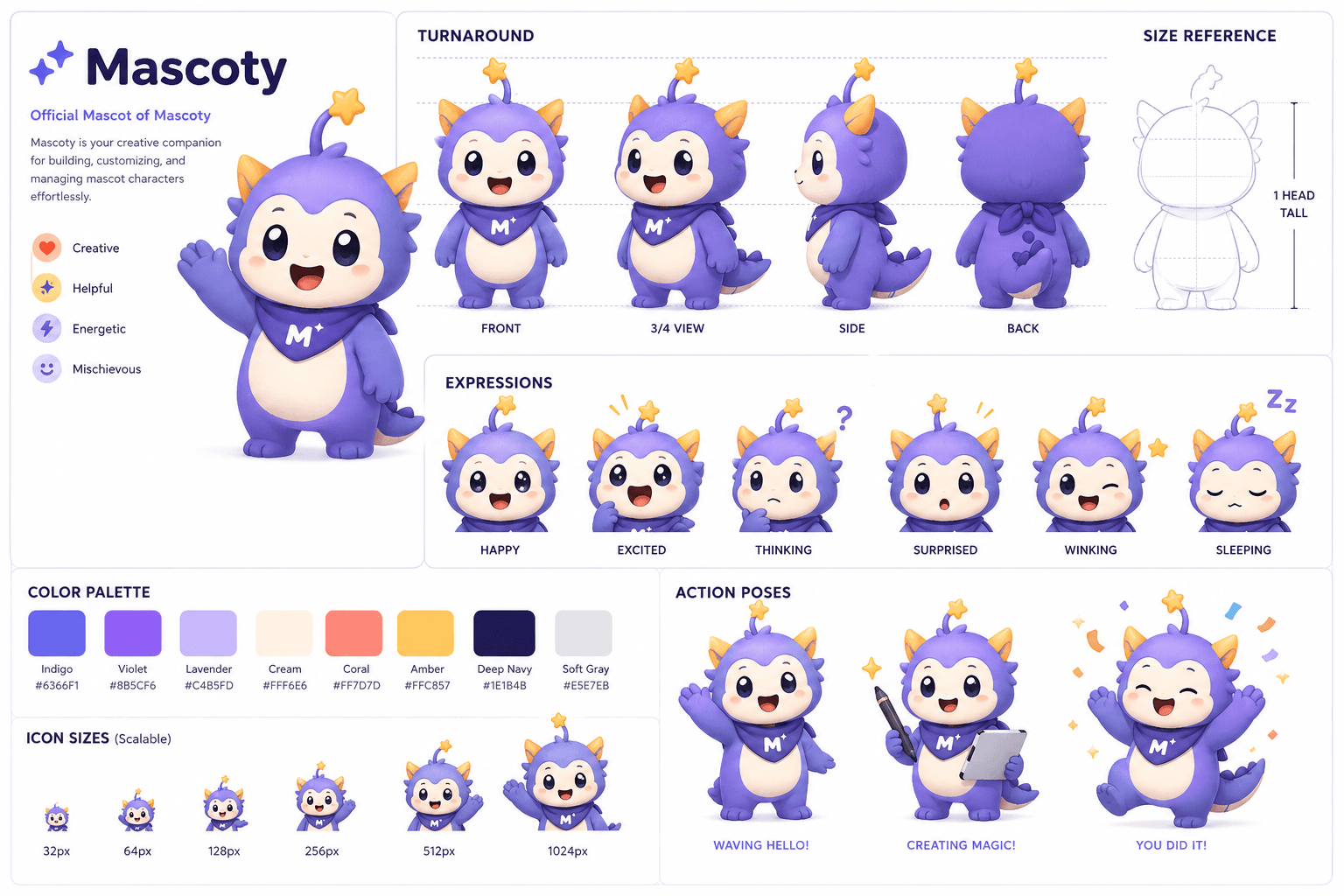
TL;DR:A brand mascot is a recurring character that represents your company across every customer touchpoint. Startups that invest in one early get three compounding advantages: memorable brand recall (faces beat logos in memory tests by 2–3×), a shared visual language across every channel, and a personality that turns transactions into relationships. This guide walks through why mascots work, what Duolingo and Mailchimp did right, how much one should cost, and how to build yours in a week — not six months.
In this guide
- What is a brand mascot (and what it isn't)
- Why startups — specifically — benefit most
- Case study: Duolingo's owl as a growth engine
- Case study: Mailchimp's Freddie
- The psychology: why faces beat logos
- Mascot vs logo: do you need both?
- What a startup mascot actually costs
- How to design yours in 7 steps
- Where to deploy it (12 touchpoints)
- Mistakes to avoid
What is a brand mascot?
A brand mascotis a recurring character — animal, human, object, or abstract creature — that personifies a company and appears across its marketing, product, and customer experience. Michelin has the Michelin Man. GEICO has the gecko. Duolingo has Duo. Mailchimp has Freddie. Mascoty has, well, a purple creature with star-tipped horns.
A mascot is not a logo. A logo is a mark; a mascot is a character. Logos exist to be recognized. Mascots exist to be related to. That distinction is the entire game — and we cover it in depth in Mascot vs Logo: Do You Need Both as a Startup?
For a full taxonomy of mascot types (animal vs anthropomorphic vs abstract) with dozens of examples, see What Is a Brand Mascot? Types, Examples & Why They Work.
Why startups — specifically — benefit most
Big incumbents can spend their way to top-of-mind: Coca-Cola doesn't need a mascot because it already owns the color red in your head. Startups don't have that luxury. You have seconds of a stranger's attention and no budget for prime-time ads. A mascot solves four startup-specific problems at once:
- Memorability at zero paid reach. A character sticks in short-term memory in a way a wordmark never will. That's a free advantage when someone sees your landing page for 3 seconds.
- Visual consistency without a design team. Once you have a character sheet, every social post, kiosk screen, slide deck, and app onboarding uses the same visual grammar. You get a “brand” without hiring one.
- Personality on a budget. Copy alone can't signal “we're friendly and fun” in the two words above your CTA button. A mascot does it before the reader parses a single word.
- A distribution engine for free. People screenshot mascots. They meme them. They ask “what's that little guy?” That's marketing that scales without a marketing hire.
Case study: Duolingo's owl as a growth engine
Duolingo's green owl, Duo, is arguably the best mascot ROI in software history. Duo is not just a cute icon — he is the product's notification voice, its TikTok persona (16M+ followers), its viral moment (“the Duolingo owl will find you”), and arguably a meaningful reason the company IPO'd at a $6.5B valuation.
The interesting move wasn't creating the owl. It was letting the owl have a personality— passive-aggressive push notifications, deranged TikToks, cameos in reminder emails — and treating that personality as a first-class product surface. Every product decision at Duolingo is filtered through “what would Duo do?”
Full teardown here: Duo the Owl: How Duolingo Turned a Mascot Into a $2B Growth Engine.
Case study: Mailchimp's Freddie
Mailchimp's winking chimp, Freddie, has been the face of the brand since 2001. Where every other email service company — Constant Contact, AWeber, Campaign Monitor — leaned into corporate professionalism, Mailchimp leaned into a chimp with a hat that winked at you when you sent a campaign. The reward — feeling like a friend giving you a high five — became so associated with the product that founder Ben Chestnut called Freddie “the reason we're not just another SaaS.”
Freddie was a big enough asset that when Intuit acquired Mailchimp for $12B in 2021, keeping the mascot was reportedly a specific condition of the deal. Not the tech. Not the customer list. The chimp.
Full teardown: Mailchimp's Freddie: The Winking Chimp That Built a Brand Empire.
Why faces beat logos: the psychology
Human brains have a dedicated region for processing faces (the fusiform face area). We are, biologically, face-recognition machines. A wordmark logo lives in the same memory bucket as a license plate. A mascot lives in the same bucket as a person you met once at a party. Guess which one you remember six months later.
There's also a well-documented effect called anthropomorphism: attaching human traits to non-human entities dramatically increases trust and emotional bond. That's why insurance companies (GEICO gecko, Progressive's Flo, Aflac duck) — industries built on trust — over-index on mascots.
The full research-backed breakdown, including brand recall data, is in The Psychology of Mascots: Why Faces Beat Logos in Brand Recall.
Mascot vs logo: do you need both?
Short answer: yes, but they do different jobs. Your logo is your signature — the mark that says “this is us” on a business card, a favicon, a footer. Your mascot is your host— the character that greets, guides, celebrates, and apologizes on your behalf across your product and marketing.
Most modern brands have both: Mailchimp has a wordmark logo and Freddie. Duolingo has a wordmark logo and Duo. The mistake is treating the mascot as a decorative flourish. It should be the primary character in your visual system, not a seasonal sticker.
Full comparison with decision framework: Mascot vs Logo: Do You Need Both as a Startup?
What does a startup mascot actually cost?
Historically, a proper mascot from a brand agency ran $5,000–$50,000and took 4–12 weeks. A freelance illustrator could do a single pose for $500–$2,000, but you'd get one drawing, not a character system: no turnaround views, no expression sheet, no palette, no usage rules. Which means the next time you need the mascot to wave, cry, or hold a phone, you're commissioning again.
AI-generated mascot tools (like Mascoty) have collapsed that to under $50 and 60 seconds for a full character sheet. The tradeoff moves from “can I afford one?” to “can I define what I actually want?” — which is where the how-to sections below matter more than ever.
Full pricing breakdown across every option: How Much Does a Brand Mascot Cost? DIY vs Agency vs AI (2026)
How to design a startup mascot in 7 steps
The compressed version:
- Define personality first, not appearance. Pick 3–5 adjectives (Friendly, Bold, Curious…). Everything else follows.
- Pick a species/form. Animal, human, object, or abstract creature. Match the personality.
- Lock the palette. 2–4 colors max. Steal from your product UI, not the other way around.
- Design a full character sheet. Turnaround, expressions, poses. Not just one drawing.
- Write a one-page style guide. Do's and don'ts for how the mascot may be used.
- Ship it everywhere in a week. Every empty state, every loading spinner, every 404.
- Give the mascot a voice. Not just a look. This is the Duolingo lesson.
Each step expanded with examples in How to Design a Startup Mascot in 7 Steps.
Where to deploy your mascot: 12 touchpoints
A common startup mistake is designing a great mascot and then hiding it in the “About” page. The character should show up in at least 8 of these 12 places on day one: landing hero, favicon, social avatar, empty states, loading spinners, 404 page, welcome email, push notifications, pitch deck cover, invoice/receipts, app store screenshots, and merchandise/stickers.
Full playbook with real examples: 12 Places to Deploy Your Mascot: From Landing Page to Loading States
Mistakes to avoid
The pattern of a failed startup mascot is remarkably consistent: a cute character that looks nothing like the product, has no personality guidelines, appears in three places, and gets quietly retired within a year. Common root causes:
- Designing appearance before defining personality
- Copying a competitor's mascot type without a reason
- Only one pose — can't adapt to new contexts
- No written style guide — every designer redraws it differently
- Treating the mascot as decoration instead of a communication tool
The full nine mistakes and their fixes: 9 Mascot Mistakes Small Brands Make (And How to Avoid Them)
Real Mascoty customers doing this well
Two case studies from brands who built their mascot in a week using Mascoty:
- Panda Charging — a powerbank rental startup that turned a character sheet into kiosk animations, sales decks, and a full visual identity.
- YonoSIM Korea — a travel eSIM brand that went from empty Figma to animated marketing video in a single day.
The bottom line
A brand mascot is not a decorative flourish. It's a compression algorithm for your brand personality — every time it appears, it does the work of three paragraphs of positioning copy. For startups fighting for the first three seconds of attention, that leverage is enormous. The tooling to build one has gone from “$5,000 and six weeks” to “$50 and a coffee break.” The question is no longer can you afford one. It's why don't you have one yet.
Ready to build yours? Generate a full character sheet with Mascoty in about a minute.